Goodman And Gilman [2025]Monitor Bandwidth, Network Bandwidth Monitor |
 |
| Home | Download | Quick Tour | Buy Now! | Screen Shots | Support | Contact |
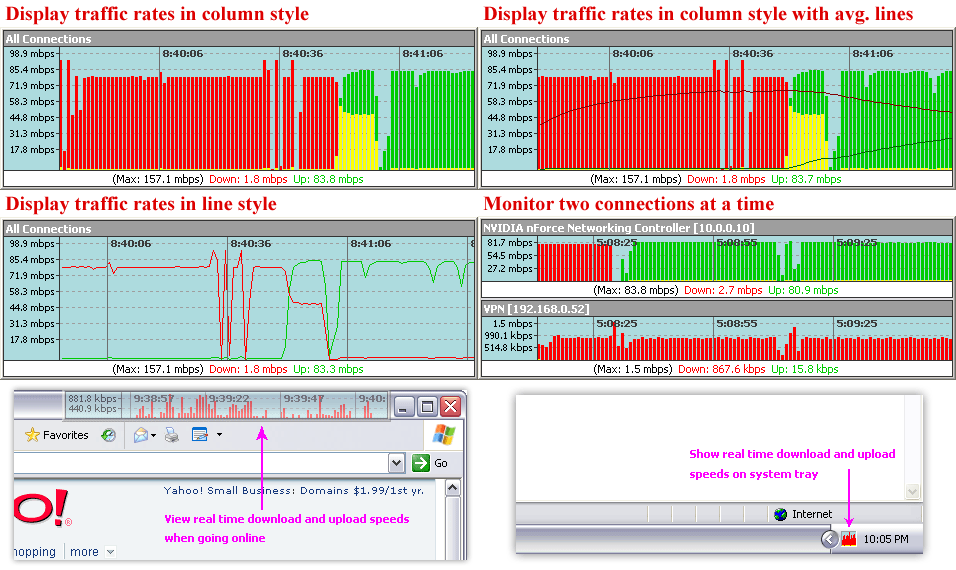
Bandwidth Monitor monitors bandwidth usages through computer it's installed on. The software displays real-time download and upload speeds in graphical and numerical forms (refer to screen shot below), logs bandwidth usages, and provides daily, weekly and monthly bandwidth usage reports. Bandwidth Monitor monitors all network connections on a computer, such as LAN network connection, Internet network connection, and VPN connection. Bandwidth Monitor also offers useful built-in utilities: speeds stopwatch, transfer rates recorder, and bandwidth usage notification. And, the software supports running as a system service that monitors bandwidth usages and generate traffic reports automatically without log on. Bandwidth Monitor works with the majority network connections including modem, ISDN, DSL, ADSL, cable modem, Ethernet cards, wireless, VPN, and more. It's full compatible with Windows 98, Windows Me, Windows NT 4.0, Windows 2000, Windows XP, Windows 2003, Windows Vista, Windows 7, Windows 8 , and Windows 10 .
How does Bandwidth Monitor Work?
Bandwidth Monitor is 100% clean and safe to install. It's certified by major download sites.  Top 11 Benefits of Bandwidth Monitor:Goodman And Gilman [2025]In popular medical culture, the phrase “Goodman & Gilman” is shorthand for rigor, depth, and orthodoxy. When a physician says, “Check Goodman & Gilman,” they are not simply suggesting a reference; they are invoking a standard of evidence and mechanistic understanding that is the polar opposite of internet hearsay or marketing brochures. As medicine moves toward personalized pharmacogenomics, artificial intelligence-driven prescribing, and complex biologics, what role remains for a monolithic textbook? The answer lies in the very principles that defined its origin. While databases can tell you that a patient with a CYP2C19 variant metabolizes clopidogrel poorly, Goodman & Gilman explains why the variant exists, how the prodrug is converted, and what alternative pathways might be exploited. AI can generate a treatment algorithm; Goodman & Gilman provides the first principles to evaluate that algorithm critically. For over eight decades, one text has stood as the undisputed colossus in the field of pharmacology: Goodman & Gilman’s The Pharmacological Basis of Therapeutics . First published in 1941, this seminal work has transcended the typical lifecycle of a medical textbook to become a cultural and intellectual touchstone. It is more than a reference; it is a bridge between the laboratory and the bedside, a historical chronicle of medical progress, and a rigorous, evolving manifesto on how drugs interact with the human body. To study Goodman & Gilman is to engage in a dialogue with the giants of 20th- and 21st-century medicine, and to understand its legacy is to understand the very architecture of modern therapeutic science. I. Historical Genesis: Forging a New Discipline The origins of Goodman & Gilman are inseparable from the professionalization of pharmacology as a distinct discipline. In the early 20th century, therapeutics was often a haphazard collection of folklore, anecdotal observation, and rudimentary chemistry. The prevailing texts were either encyclopedic compendia of drug doses with little mechanistic explanation or purely physiological treatises that ignored clinical application. It was into this void that two young American pharmacologists, Louis S. Goodman and Alfred Gilman, stepped. goodman and gilman Furthermore, the text has never shied away from complexity. The chapter on anticancer agents (chemotherapy) is a daunting but brilliant tour through the cell cycle, DNA replication, and the logic of combination therapy. The sections on psychopharmacology (antidepressants, antipsychotics, anxiolytics) navigate the treacherous waters of neurochemistry and behavior with a rigor that avoids reductionism while rejecting mere phenomenology. No monument is without its shadow. The very depth that makes Goodman & Gilman a masterpiece also renders it a challenge. At nearly 2,000 pages, it is not a text for the faint of heart or the rushed clinical rotation. Critics have long noted that its density can overwhelm first-year medical students, who may turn to condensed outlines or digital question banks. The book’s resistance to listing clinical dosing guidelines—while philosophically pure—can frustrate the resident physician in the middle of a night shift who simply needs a safe starting dose of a thrombolytic. In popular medical culture, the phrase “Goodman & Two chapters, in particular, have become legendary among students and practitioners. is often cited as the finest single introduction to the mathematics and principles of drug action ever written. It introduces concepts like volume of distribution, clearance, half-life, and receptor theory with a clarity that has never been surpassed. Chapter 5, “Principles of Toxicology,” similarly, is a masterclass in applied physiology, treating poisoning not as a series of antidotes but as an extension of extreme pharmacokinetics. The answer lies in the very principles that Consider, for example, its treatment of digitalis (cardiac glycosides). A lesser text might list indications for heart failure and atrial fibrillation, common doses, and signs of toxicity. Goodman & Gilman instead begins by explaining the sodium-potassium ATPase pump, its role in cardiac myocyte calcium handling, and how inhibition of this single enzyme leads to increased contractility. Only then does it connect the mechanism to the clinical benefit—and critically, to the arrhythmogenic toxicity that arises from the same mechanism. This pedagogical approach has an almost Socratic effect: it teaches the reader to think like a pharmacologist, not merely to act like a pharmacist. Over thirteen editions (the latest in 2018, with a fourteenth in progress), the structure has matured while preserving its soul. The book is divided into logical sections: General Principles, Neuropharmacology, Cardiovascular, Inflammation & Immunomodulation, Endocrine, Chemotherapy (infectious disease and oncology), and Toxicology. Each section is curated by a leading expert in the field, ensuring that the content is both authoritative and current. Moreover, the rapid pace of drug discovery in the era of biologics, gene therapy, and small-molecule inhibitors presents a perennial problem. By the time a new edition is printed, several blockbuster drugs have emerged, and a few have already been withdrawn. The 13th edition, for instance, incorporated novel agents for hepatitis C and immunotherapy for cancer, but the lag between manuscript submission and publication remains an unavoidable reality. Bandwidth Monitor Key Features:
Bandwidth Monitor Quick Info:
|


| Home | Download | Quick Tour | Buy Now! | Screen Shots | Awards | Support | Contact | Links |
| Copyright © 2005-2017 BWMONITOR.COM All rights reserved. Privacy Policy |