|
|
|
|
|
|
|
|
|
|
|
|
|
|
 |
|
||||||||||||
|
|
|
|
|
|
|
|
|
|
|
|
|
|
|
|
|
||||||||||||
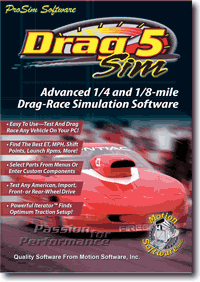
| DragSim5 Vehicle-Dynamics 1/4- or 1/8-Mile Drag-Strip Simulation Includes ProTools™ Enhancements | ||||
|
DragSim5™
with ProTools™ is an
amazingly accurate 1/4- and 1/8-mile vehicle-dynamics
simulation for
Windows Vista, 7, 8, and 10 (32- and 64-bit) from the
experts at Motion Software, Inc. The simulation lets you to design and build any car, motorcycle or dragster
and accurately evaluate its performance at simulated dragstrip! Enter
any engine power curve, or test engines you've designed in DynoSim or Dynomation (you
can even test a variety of jet and rocket power plants!).
Test any manual or automatic transmissions, any gear ratios, any vehicle
weight, wheelbase, driving style, weather and traction conditions and more! Change
components with just a mouse click—drag-race times are instantly
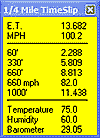
updated. A PopUp TimeSlip™ provides an easy-to-read visual summary of
overall vehicle performance. Even
test and compare multiple vehicles at once! Software Overview: DragSim5 simulates virtually any Automobile, Dragster, or Motorcycle using front- or rear-wheel drive! The simulation performs a comprehensive analysis of the physics that act on the vehicle as it accelerates from a standing start to terminal velocity over the 1/8- or 1/4-mile. This iterative (repeating, step-by-step) analysis determines vehicle performance for each fraction of an inch throughout the entire race. The results display looks similar to a professional data-acquisition system! You'll clearly see exact elapsed times, speeds, rpms, beginning at rollout to 60 feet, 330 feet, 660 feet (1/8-mile), 1000 feet, and 1320 feet (1/4-mile). ETs and speeds can be compared with up to four other vehicles to help locate the best component combinations. User Interface And
Features: DragSim5 has a completely
unique user interface built from the
ground-up to be clear and easy use. You'll find vehicle component parts and
specifications on the left side of the screen, and simulation results on the
right! Eye-popping graphics are Even though this program is sophisticated, DragSim5 was carefully designed to be easy to use. For example, a Pop-Up TimeSlip™ provides an instant summary of the performance potential of any vehicle. A quick glance will help you make judgments about gear ratios, shift points, vehicle weight, and it can even help you evaluate traction and wheelspin!. Similar to the paper time slip delivered to racers at the end of a run, the DragSim5 Pop-Up TimeSlip™ is a helpful, at-a-glance analysis of track results.
ProTools™: Professionals need all the modeling power they can get. The ProTools™ included in DragSim5 extend the functionality of many program features. For example, the ProIterator™ lets you perform fully custom testing, DataZones™ give you the most graphing and data analysis power possible, ProData™ includes a new table of extended vehicle performance data, and ProPrinting™ prints out a comprehensive test report that can include your name, address, custom logo, glossaries, and all ProData™ values. If you're serious about drag racing, the DynoSim5 with ProTools™ was made for you! Technical (under the
hood):
DragSim5 simulates the complex physics involved in 1/8- and
1/4-mile drag racing, including the incredible range of forces that act on
automobiles, dragsters, or motorcycles at the starting Users Manual: The DragSim5 is supplied with a full-color on-disk Users Manual (directly accessible from within the program) that details the features of this comprehensive simulation. If you wish, you can download a copy of this manual to preview the capabilities of this software before you buy (link provided at top of this page). Requirements: DragSim5 runs on any Windows 7, 8 10 or 11 equipped PC. A video display of 1024 x 768 resolution or greater is recommended. A Windows-compatible printer is required for test reports. Availability: The DragSim5 is available NOW!. See our Order Page for purchase information and Discount pricing. What You Can Do With The DragSim:
Tune These Key Vehicle Components:
What The Pros Say About The DragSim:
|
Compare Our Drag
Simulation
FREE—Download
Special Web Pricing What's New This Version:
Features:
Requirements:
|
|||
|
|
|
|
|
|
|
|
|
|
|
|
|
|
In conclusion, the transgender community is not an auxiliary component of LGBTQ culture but its conscience and its cutting edge. From the cobblestones of Stonewall to the debates of modern legislatures, trans people have been architects of resistance and redefinition. While internal tensions and unique challenges exist, they are symptoms of a maturing movement, not signs of incompatibility. The history, philosophy, and future of LGBTQ culture are unintelligible without the central contributions of the transgender community. To separate them would be to drain the movement of its radical heart, leaving behind a comfortable identity politics that seeks assimilation over authentic liberation. Ultimately, the strength of the rainbow lies in every one of its colors, and the trans community ensures that the banner of LGBTQ culture continues to stand for the limitless possibilities of being human.
Historically, the transgender community has been an active, if often erased, participant in the struggle for sexual and gender liberation. Long before the Stonewall Riots of 1969 became the symbolic birth of the modern gay rights movement, trans figures like Marsha P. Johnson and Sylvia Rivera were on the front lines. Johnson, a self-identified gay transvestite and drag queen, and Rivera, a Latina trans woman, were not just present at Stonewall; many accounts credit them with igniting the pivotal moment of resistance against police brutality. Their leadership underscores a crucial truth: the fight against homophobia is inextricably linked to the fight against transphobia. The very same police and legal systems that raided gay bars also targeted individuals who defied gender norms, criminalizing their very existence. Thus, the DNA of LGBTQ activism contains essential transgender strands. shemaler tube
In contemporary society, the transgender community has become the vanguard of a new wave of LGBTQ culture. As legal battles for same-sex marriage have been won in many Western nations, the cultural and political spotlight has shifted to transgender rights, with debates over bathroom access, sports participation, and healthcare for minors. In this environment, the broader LGBTQ community faces a test of solidarity. True coalition means supporting the most vulnerable members, not abandoning them when the political climate becomes hostile. The vibrant celebration of Transgender Day of Visibility, the increasing inclusion of non-binary options on forms, and the growing acceptance of neopronouns are all testament to how transgender leadership is pushing LGBTQ culture toward a more expansive, inclusive, and radical future—one that questions all rigid categories of identity. In conclusion, the transgender community is not an
Beyond the Acronym: The Integral Role of the Transgender Community in Shaping LGBTQ Culture The history, philosophy, and future of LGBTQ culture
Culturally, the transgender community has profoundly expanded the lexicon and consciousness of LGBTQ identity. The modern gay and lesbian rights movement, in its mid-20th century iteration, often sought acceptance by arguing that sexual orientation was immutable and that gay people were “just like” heterosexuals in every way except for their partner choice. This strategy, while pragmatic at the time, frequently marginalized those whose identities challenged binary norms of gender. The rise of transgender activism and theory introduced powerful concepts like gender identity (one’s internal sense of self) versus sexual orientation (who one is attracted to). This distinction was revolutionary. It allowed for a more nuanced understanding of all identities, from cisgender gay men to bisexual non-binary people. Furthermore, the transgender community’s emphasis on self-identification and the rejection of external medical or social gatekeeping has emboldened the entire LGBTQ community to claim their identities on their own terms, moving beyond diagnostic labels and towards personal liberation.
The tapestry of human identity is woven with threads of varied colors, and few threads are as vibrant, historically significant, or currently contested as those representing the transgender community within the broader LGBTQ (Lesbian, Gay, Bisexual, Transgender, and Queer) movement. While often grouped under a single acronym, the relationship between transgender individuals and the wider LGBTQ culture is complex: it is a story of shared struggle, mutual influence, internal tension, and ultimately, an inseparable bond. The transgender community is not merely a subset of LGBTQ culture; it is a foundational pillar that has fundamentally shaped the movement’s philosophy, resilience, and ongoing fight for authenticity.
However, the integration of the transgender community into mainstream LGBTQ culture has not been without friction. The “LGB without the T” movement, though a small minority, represents a painful schism. These arguments often hinge on a flawed distinction between “sexuality” (deemed innate and acceptable) and “gender identity” (deemed a choice or ideology). This internal conflict mirrors the very respectability politics that early gay activists used to exclude bisexuals, drag queens, and gender-nonconforming people. Moreover, the transgender community faces unique challenges that sometimes diverge from the priorities of cisgender (non-transgender) LGB individuals, such as access to gender-affirming healthcare, legal recognition of name and gender markers, and protection from specific forms of violence, particularly against trans women of color. These challenges require distinct advocacy, yet they are most effectively addressed when the broader LGBTQ culture recognizes that the fight for trans rights is the fight for the core principle of bodily autonomy and self-determination for all.

 performance or
racing application, automatically! DragSim5 is the most powerful and
easy-to-use straight-line vehicle-dynamics simulation available! And it’s
fun to use, too!
performance or
racing application, automatically! DragSim5 is the most powerful and
easy-to-use straight-line vehicle-dynamics simulation available! And it’s
fun to use, too!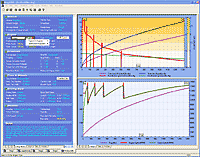 enhanced with
QuickAccess™ buttons and
DirectClick™
menus that let you change parts simply by clicking on any component. Analyze engine
RPM, Clutch RPM, Torque Converter Stall Speed, Acceleration, Tire Slip, Distance, ET, Aero Drag, and much more
(detailed below). All data and graphs can be
printed (and previewed) in color.
enhanced with
QuickAccess™ buttons and
DirectClick™
menus that let you change parts simply by clicking on any component. Analyze engine
RPM, Clutch RPM, Torque Converter Stall Speed, Acceleration, Tire Slip, Distance, ET, Aero Drag, and much more
(detailed below). All data and graphs can be
printed (and previewed) in color.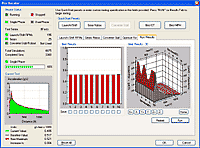 DragSim5 also incorporates
(Motion-exclusive) technology that helps you find
optimum combinations for any vehicle. To
start off,
the simulation includes a
Traction Calculator™ that optimizes tire/track modeling and
improves accuracy. A simple button click begins a comprehensive series of
hundreds of thousands of calculations to determine the tire/track adhesion
model that best simulates read-world conditions. You'll also be amazed by
Iterator™ testing built into DragSim5 that lets you "home in" on the best parts combinations, automatically!
Click one button and DragSim will perform hundreds,
or thousands of
drag tests! The Iterator™ keeps
track of all the results, and displays the best gear ratios and other parts combinations for you to review.
You'll locate the setup that delivers the quickest ET or the fastest MPH for any
street or racing application!
DragSim5 also incorporates
(Motion-exclusive) technology that helps you find
optimum combinations for any vehicle. To
start off,
the simulation includes a
Traction Calculator™ that optimizes tire/track modeling and
improves accuracy. A simple button click begins a comprehensive series of
hundreds of thousands of calculations to determine the tire/track adhesion
model that best simulates read-world conditions. You'll also be amazed by
Iterator™ testing built into DragSim5 that lets you "home in" on the best parts combinations, automatically!
Click one button and DragSim will perform hundreds,
or thousands of
drag tests! The Iterator™ keeps
track of all the results, and displays the best gear ratios and other parts combinations for you to review.
You'll locate the setup that delivers the quickest ET or the fastest MPH for any
street or racing application!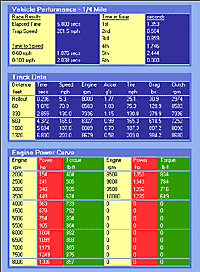 line. But you can leave your physics books on the shelf, because the
DragSim5 makes complex vehicle analysis as easy as 1, 2, 3. Pop-up menus allow you to enter any
engine power curve (also import DynoSim6 and Dynomation6 and other engine files). You can even test jet
or rocket power plants! Then choose vehicle components from simple drop-down
menus or enter custom specs for automatic or manual transmissions, torque
converter stall-speed, launch rpm, shift rpms, up to six transmission gears
with virtually any gear ratios, rear-axle ratios, vehicle weight, wheelbase,
front- or rear-wheel drive, frontal area, aero drag, tire width, rollout
distance, ambient temperature, humidity, wind speed, and more! Internal
"watchdogs" eliminate conflicting choices (like an rpm redline rpm set lower
than a shift rpm, etc.), ensuring accurate performance predictions.
line. But you can leave your physics books on the shelf, because the
DragSim5 makes complex vehicle analysis as easy as 1, 2, 3. Pop-up menus allow you to enter any
engine power curve (also import DynoSim6 and Dynomation6 and other engine files). You can even test jet
or rocket power plants! Then choose vehicle components from simple drop-down
menus or enter custom specs for automatic or manual transmissions, torque
converter stall-speed, launch rpm, shift rpms, up to six transmission gears
with virtually any gear ratios, rear-axle ratios, vehicle weight, wheelbase,
front- or rear-wheel drive, frontal area, aero drag, tire width, rollout
distance, ambient temperature, humidity, wind speed, and more! Internal
"watchdogs" eliminate conflicting choices (like an rpm redline rpm set lower
than a shift rpm, etc.), ensuring accurate performance predictions.